It was the vibrant colours in the old pattern book that fired up Anne Kirker’s fascination with Sam Hill of Soyland. The survival of Sam Hill’s extensive archive, held in the Calderdale Archives, has made him one of the best known of the 18th century textile manufacturers. Reading his letters – business and personal – brought the man to life, and Anne’s talk to Hebden Bridge Local History Society aimed to show us there was more to Sam Hill than textiles.
One of the most striking things was his immense wealth - an annual turnover of more than £30,000. He was an innovative entrepreneur, moving in the 1730s from kerseys to the finer and more valuable worsted cloths whose bright colours glow in the pattern book. His letters and order books reveal the extent of his workforce and his exports of cloth across Europe. His workforce was massive as he directly employed people across the whole process of producing and transporting his pieces of cloth.
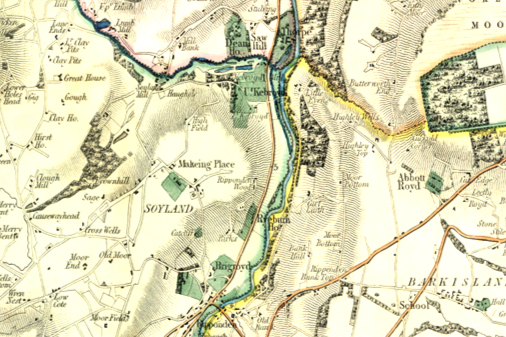
Making Place was Sam’s grand house in Soyland and the centre of his business empire. It had great vistas over the fields of Soyland. Letters and invoices show that it was elegantly and expensively furnished with fashionable items such as tea tables. Sam seems to have been a sociable and generous man whose business associates and customers were also his friends. He expressed his pleasure in spending an evening of convivial talk, and was frequently sending gifts of Yorkshire hams to his friends.
He was a Church trustee and used his skills and contacts to raise money for charity. He received pleas for financial assistance and would try to persuade creditors to settle the debts, underwriting the loans. He argued that by helping the needy they could help themselves get to heaven.
Like other wealthy citizens Sam looked for profitable investments, and turned to property. A list drawn up in his own hand in the year before his death in 1759 details more than fifty properties in the Soyland, Sowerby and the Ryburn Valley. He assigns a value to each of them. Among the most valuable were the Soyland mills and kilns at Mill Bank worth more than £2000. Many of these properties have been substantially changed or rebuilt, but it is still the case that the small town of Soyland has some of the best Georgian houses in Calderdale, and in many of them it is possible to see something that Sam Hill would have recognised.
Behind the success story however there is a more tragic family drama. Sam outlived all his children except for his son Richard, who at first was an active partner in the business. However he and his father had a serious quarrel arising from Sam’s hostility to Richard’s choice of wife. Richard had been bankrupted and imprisoned for debt, so at his death Sam disinherited his son, leaving his money to his grand-daughter. His affairs were so complicated and family feelings so acrimonious that it took forty five years to settle his will.